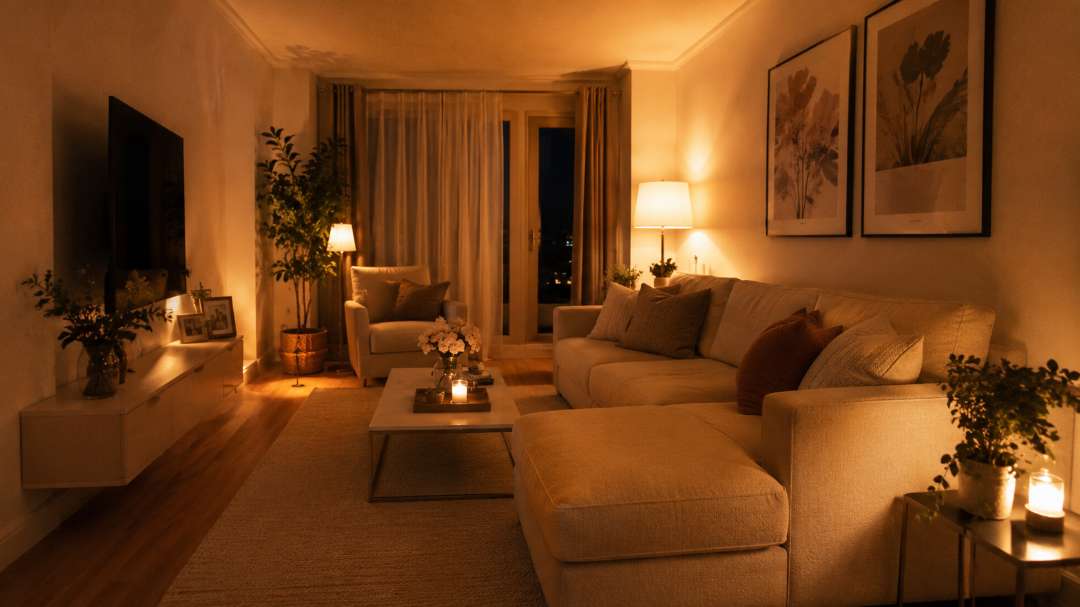
27 Small Living Room Ideas That Look Expensive on a Budget
This guide is the counter-argument. These are 27 small living room ideas that look expensive on a budget — tested, practical, and grounded in the same principles that professional designers use, stripped of everything that requires money rather than intention.
The most beautiful living rooms are rarely the most expensive ones. They are the most intentional ones.
A room with three carefully chosen pieces looks more considered than a room packed with fifty mediocre ones. A single large mirror in the right position does more for a small living room than three hundred dollars of decorative accessories scattered without purpose. A pot of paint in the right shade transforms a space in an afternoon for the cost of a restaurant lunch.
Nobody told us these things. We were supposed to believe that beautiful rooms required budgets we did not have, furniture we could not afford, and a professional designer to make sense of it all.
Start anywhere on this list. The room will tell you what it needs next.
Key Takeaways
- The most impactful small living room transformations cost almost nothing — lighting, decluttering, and furniture repositioning are free
- Mirrors, curtains hung high and wide, and a single large rug are the three budget investments with the biggest visual return
- Thrift stores, Facebook Marketplace, and DIY painting are the three best sources for affordable expensive-looking pieces
- The 2026 aesthetic direction for small living rooms favours warm, layered, and intentionally personal spaces over minimalist and generic ones
- Less is almost always more in a small living room — editing down to fewer, better pieces is free and immediately effective
- Every idea in this guide is achievable for under 100.Mostforunder30.
Why Small Living Rooms Look Better Than Large Ones When Done Right
Before diving into the ideas, it is worth addressing the assumption that a small living room is a problem to be solved. It is not.
Small living rooms have an inherent quality that large ones spend money trying to create: intimacy. A well-decorated small living room feels like a place where conversations happen, where evenings are spent well, where the proportions of the space match the human scale of the people in it.
The challenge is not the size. The challenge is working with it rather than against it. Every idea in this list does exactly that.
27 Small Living Room Ideas That Look Expensive on a Budget
LIGHTING IDEAS
1. Replace Every Bulb With Warm White 2700K LEDs
The single fastest and cheapest way to transform a small living room costs under fifteen dollars and takes twenty minutes. Replace every light bulb in the room with warm white LED bulbs at 2700K colour temperature.
Cool white bulbs — the standard that comes in most light fittings — flatten every surface, wash out warm colours, and make rooms feel institutional and clinical regardless of how they are decorated. Warm white bulbs at 2700K do the opposite. They deepen wood tones, make fabric textures glow, bring out the warmth in wall colours, and create the kind of amber-toned light that makes small living rooms feel like the most inviting place in the house.
This change costs approximately ten to fifteen dollars for a full room transformation and is the foundation upon which every other lighting idea in this list builds. Do it first. Do it today.
Cost: 10to15
Impact: Immediate and dramatic
Tips:
- Go for 2700K specifically — 3000K is acceptable but noticeably cooler. Anything above 3000K is too cool for a warm living room aesthetic
- Replace all bulbs in the room simultaneously — mixed colour temperatures look inconsistent and chaotic
- Dimmable warm LEDs allow you to adjust the atmosphere from bright working light to deeply cosy evening ambience
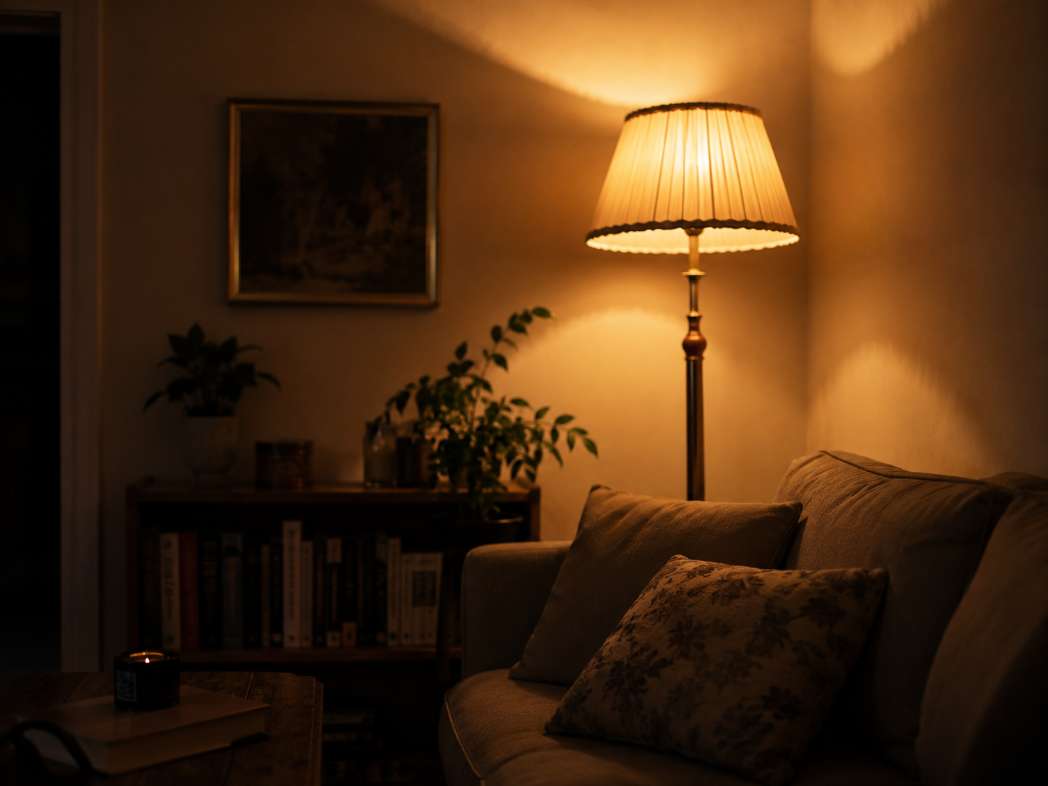
2. Add a Floor Lamp in a Dark Corner
Every small living room has at least one dark corner — an area where the overhead light does not reach properly and the space retreats into shadow. That shadow is not a design problem. It is an opportunity.
A floor lamp placed in a dark corner does two things simultaneously. It fills the corner with warm, upward-directed light that warms the ceiling above it and creates a soft, layered glow across the room. And it fills the corner visually — making use of a space that would otherwise be dead and empty and visually reducing the usable area of the room.
Thrift stores regularly have floor lamps for five to twenty dollars. A warm LED bulb replacement in a thrifted floor lamp costs two dollars. The visual result is indistinguishable from a two-hundred-dollar designer floor lamp.
You May Like: DIY Aesthetic Room Decor Ideas on a Budget (2026 Guide)
Cost: 5to25 (thrifted) or 30to60 (new budget options)
Impact: High — layered lighting is the most significant affordable upgrade to any room
Tips:
- Place the lamp behind a sofa or beside an armchair rather than in the middle of the room for the most flattering light angle
- A lamp with a fabric shade diffuses the light more warmly than a bare bulb or clear glass shade
- Tall floor lamps draw the eye upward, which makes ceilings feel higher in small rooms
3. Hang String Lights Above or Behind the Sofa
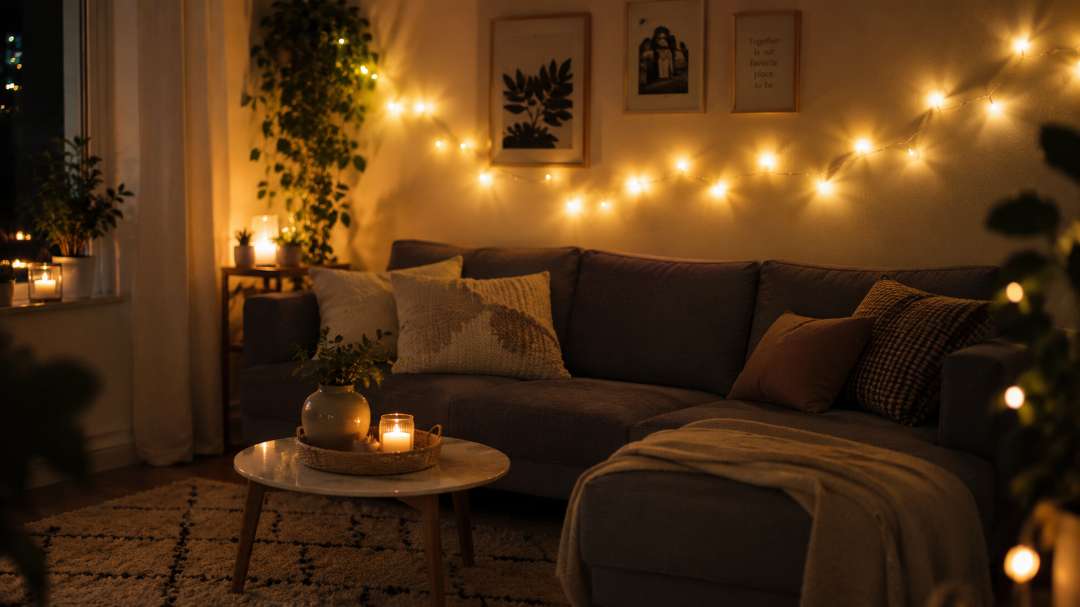
Battery-operated warm LED string lights hung along the wall above the sofa, draped behind a bookshelf, or arranged along the top edge of a curtain create a soft background glow that makes the entire living room feel wrapped in warmth.
This is one of the most Pinterest-popular small living room lighting ideas because the result photographs beautifully — which is a reliable indicator that it also looks genuinely beautiful in person. The soft point-source light of string lights creates depth and warmth across the room without requiring any electrical work, any drilling, or any significant expense.
Battery-operated options hang anywhere using adhesive hooks. Plug-in options run along skirting boards or behind furniture to the nearest outlet. The total investment is eight to eighteen dollars for a strand that transforms the evening atmosphere of a small living room completely.
Cost: 8to18
Impact: Medium-high — particularly effective for evening atmosphere
Tips:
- Choose warm white string lights only — cool white string lights create the opposite of the intended effect
- Copper wire string lights look more refined than plastic-coated wires
- Hang lights along the ceiling line of one wall for a canopy effect that makes the room feel more intimate
COLOUR AND WALLS
4. Paint One Accent Wall a Deep, Rich Colour
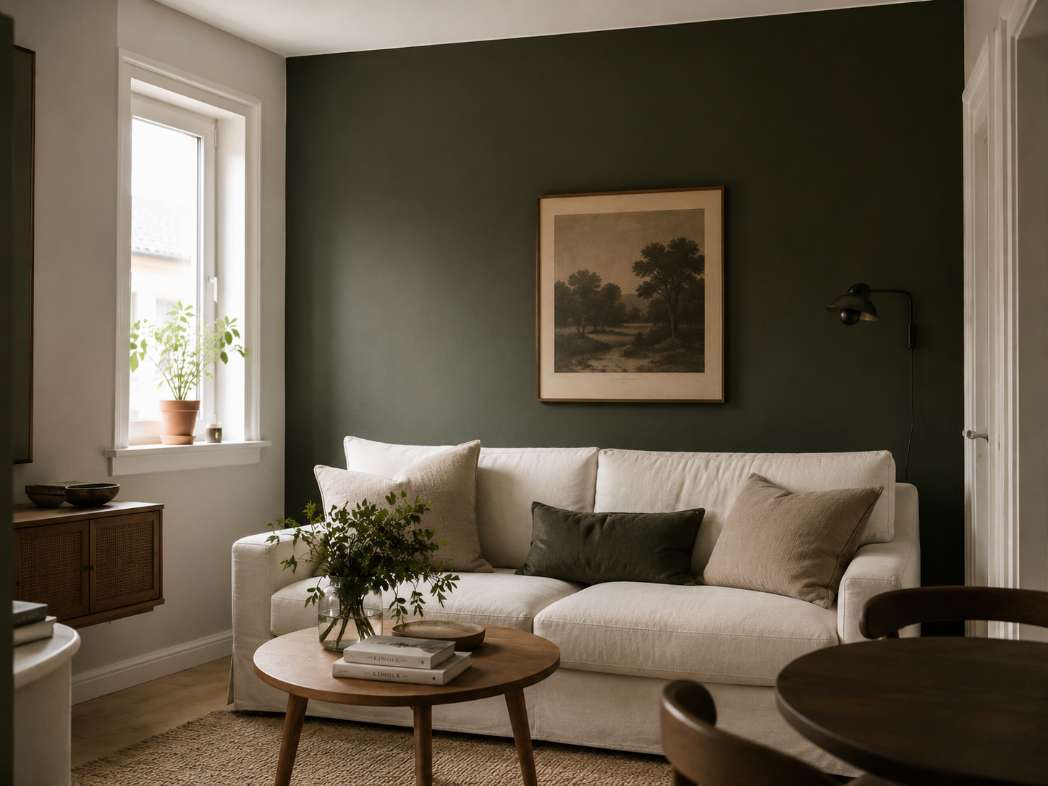
A single accent wall painted in a deep, saturated colour is the most dramatic room transformation achievable for under forty dollars. One wall. One weekend afternoon. Complete visual transformation.
The specific colour choice matters enormously. For a small living room that wants to look expensive and intentional, reach toward the deep end of the palette — forest green, midnight navy, warm terracotta, deep charcoal, rich plum, or dark sage. These colours communicate confidence and considered design in a way that beige and greige simply cannot.
Use a flat or matte finish for the deepest, most atmospheric result. High-sheen paints on accent walls in small rooms reflect light in ways that can feel harsh and disruptive. Flat paint absorbs light and creates depth, which is the quality that makes painted accent walls look expensive rather than cheap.
Cost: 20to40 for a small can of quality paint
Impact: Very high — one of the most significant aesthetic transformations on this list
Tips:
- Paint the wall behind the sofa or the fireplace wall for the most architectural impact
- Use painter’s tape at the edges for clean, professional-looking lines
- Two thin coats always look better than one thick coat — thin coats dry faster and apply more evenly
- A deep coloured accent wall makes artwork hung in front of it look more gallery-like and expensive
5. Paint Your Skirting Boards and Door Trim White or Very Light
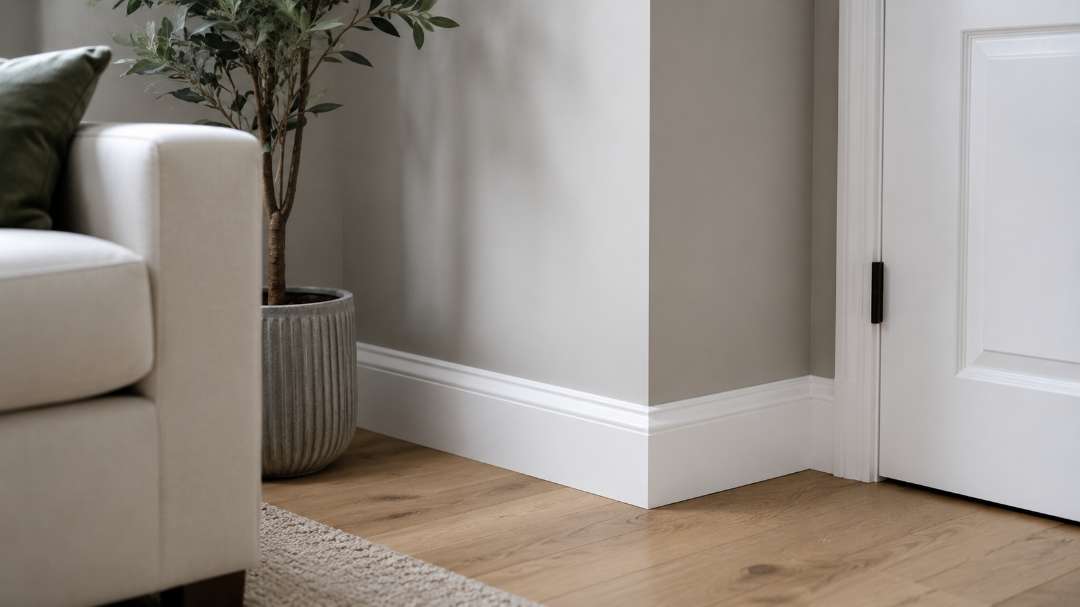
Freshly painted skirting boards and door trim in a clean, bright white or soft off-white create a crisp architectural outline that makes the room feel more finished and intentional. This is one of the oldest tricks in the property staging playbook — it costs under twenty dollars in paint and creates the impression of a recently renovated space.
In a small living room where every detail is visible from almost any position in the room, the state of the skirting boards and door frames has a disproportionate impact on the overall quality of the space. Yellowed, scuffed, or dirty trim makes a whole room feel tired regardless of what else is in it. Freshly painted bright white trim frames the room like a picture frame and immediately elevates everything within it.
Cost: 15to25 in paint and materials
Impact: Medium — most noticeable in rooms with older or discoloured existing trim
Tips:
- Gloss or semi-gloss paint is correct for trim — it is more durable and easier to clean than flat
- Remove furniture away from walls before painting trim for the cleanest result
- Fresh white trim makes dark walls look even more dramatic and intentional
6. Use Removable Wallpaper on One Wall
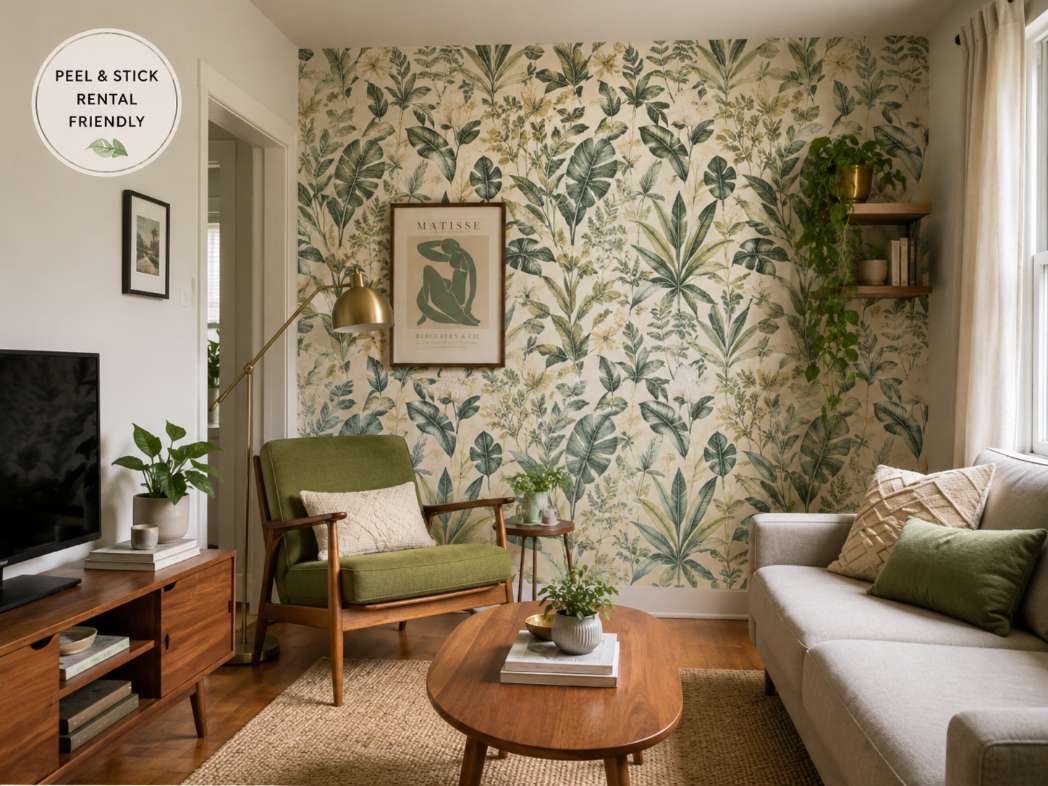
For renters or anyone who is not ready to commit to paint, removable peel-and-stick wallpaper on one feature wall delivers comparable visual impact to paint at a similar cost and with zero permanent commitment.
In 2026, the quality and variety of removable wallpaper has reached a point where even interior designers use it in professional projects. Botanical prints on dark backgrounds, geometric patterns, grasscloth textures, and abstract artistic designs are all available in peel-and-stick formats that apply cleanly, look convincing from any normal viewing distance, and remove without leaving marks.
One panel of removable wallpaper applied behind the sofa or along the main view wall of a small living room changes the entire character of the space for twenty to fifty dollars. The impact-to-cost ratio is excellent.
Cost: 20to50 for a feature wall
Impact: High — particularly for renters who cannot paint
Tips:
- Apply to a clean, smooth, dry wall for the best adhesion
- Start from the top of the wall and work downward, smoothing bubbles with a credit card as you go
- Botanical and textured designs are the most forgiving of minor application imperfections
FURNITURE ARRANGEMENT AND FUNCTION
7. Float Your Furniture Away From the Walls
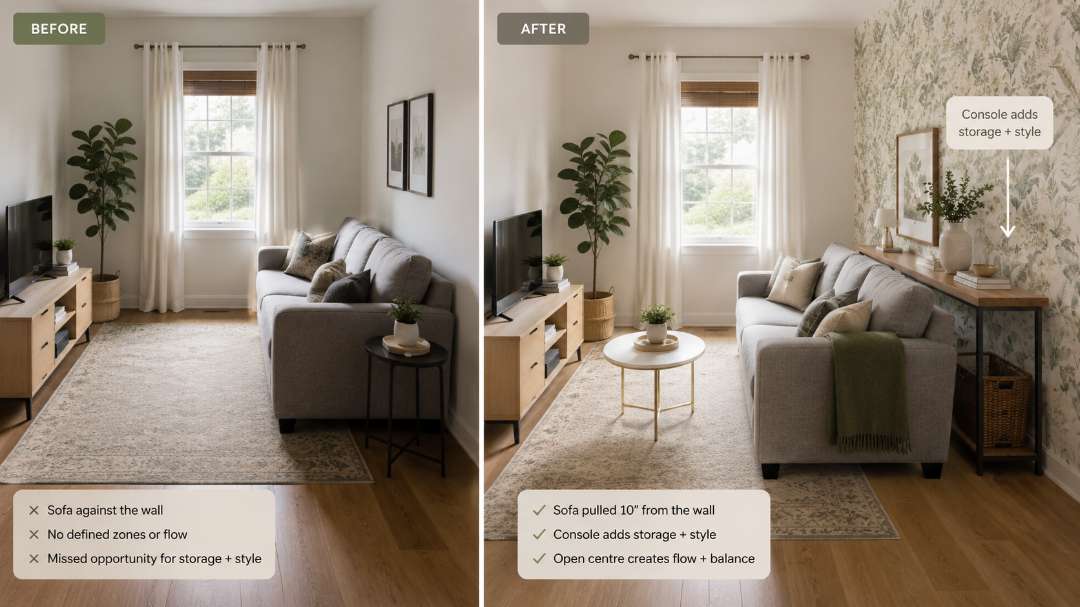
This is the counterintuitive arrangement rule that designers know and most homeowners break: furniture pushed against walls in a small living room makes the room feel smaller, not bigger.
When every sofa and chair is shoved to the perimeter of the room, the centre of the room becomes a void of empty floor. The room reads as smaller than it is because all the activity and interest is trapped around the edges.
Moving the sofa even eight to twelve inches away from the wall brings it into the room, creates a clear sense of a designed conversation zone, and makes the overall layout feel more considered and more spacious simultaneously. It is free. It takes ten minutes. And the visual difference is remarkable.
Cost: Free
Impact: High — one of the most immediately effective non-purchase room transformations
Tips:
- The sofa should be the piece you pull away from the wall most significantly
- Leave a small gap of a few inches between the sofa back and the wall rather than floating the sofa to the centre of the room
- A rug placed under the front legs of the floating sofa anchors the arrangement and makes it feel intentional
8. Use One Large Piece Rather Than Several Small Ones
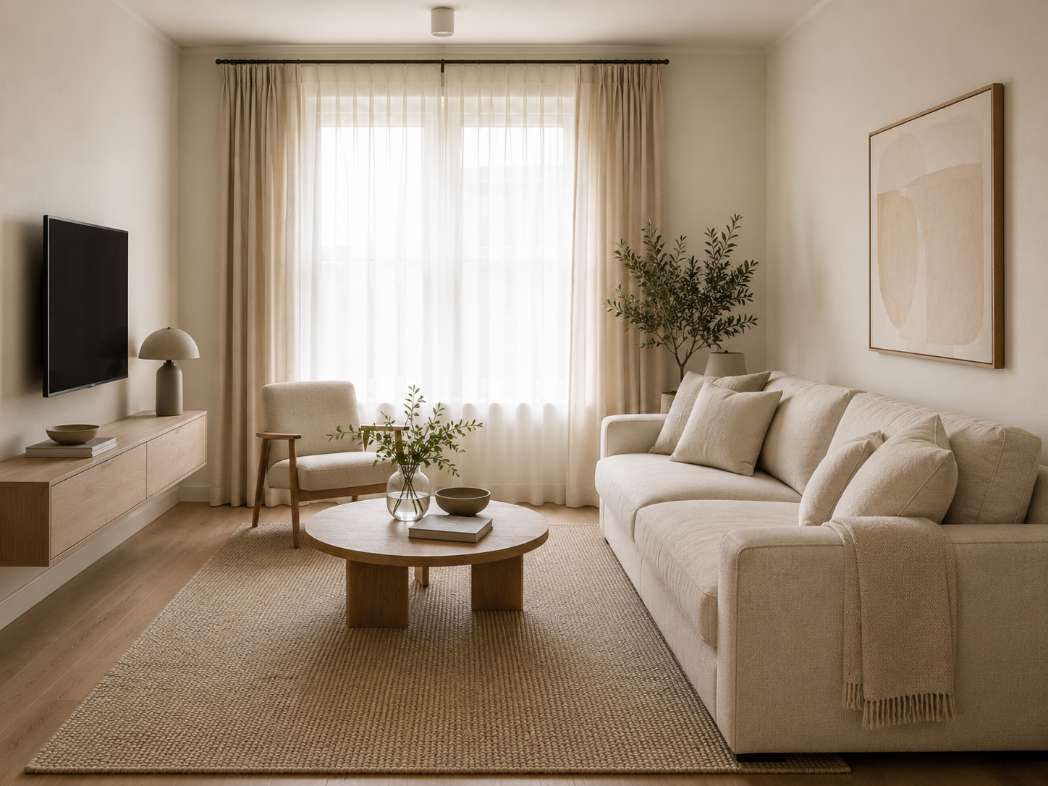
A common small living room mistake is choosing small-scale furniture to match the small-scale room. This almost always makes the room look more cluttered and less intentional than one or two larger anchor pieces would.
A single large sofa, one substantial armchair, or one big bookshelf makes a more confident and more expensive-looking statement than three smaller pieces covering the same footprint. The scale of the furniture communicates design confidence — and design confidence is what makes a room look expensive.
If your current furniture is a collection of small, mismatched pieces, consider whether consolidating or replacing with fewer larger items would improve the overall look. Facebook Marketplace and thrift stores often have substantial, quality pieces at very low prices.
Cost: Free if rearranging existing furniture, variable if replacing
Impact: High — scale is one of the primary visual indicators of design sophistication
Tips:
- A sofa with clean lines and a single fabric colour looks more expensive than a heavily patterned or multi-coloured one regardless of actual cost
- Multi-purpose furniture — an ottoman that serves as a coffee table, a storage bench that doubles as seating — is particularly valuable in small living rooms
9. Add a Storage Ottoman as Your Coffee Table
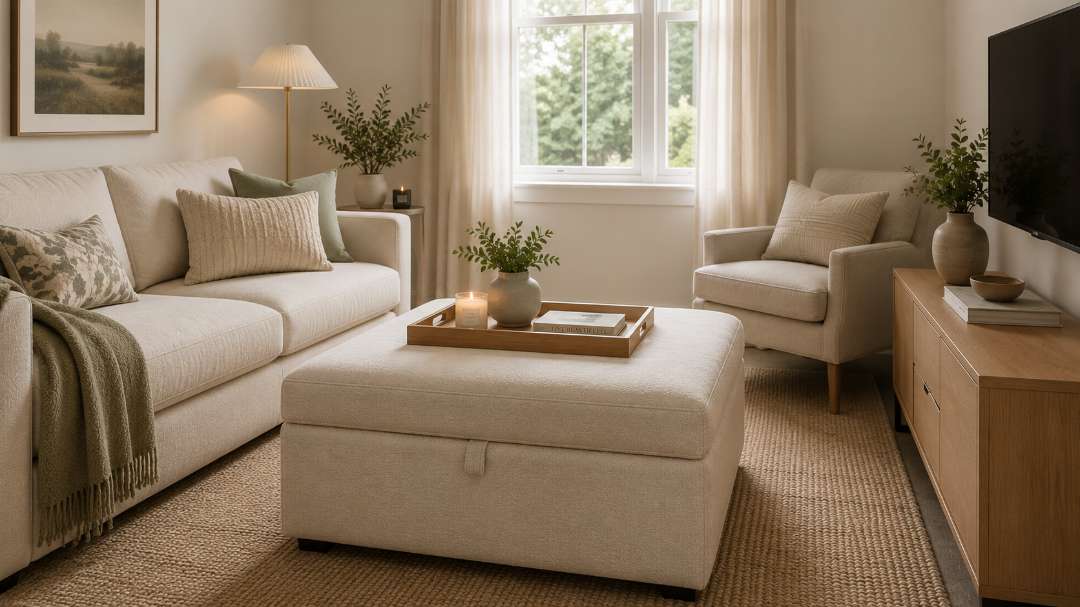
A large, upholstered storage ottoman used as a coffee table instead of a conventional table is one of the most practical and aesthetically significant furniture choices available for a small living room.
It provides a surface for drinks, books, and remote controls (add a small tray on top to create a stable, flat surface). It provides hidden storage for blankets, remotes, magazines, and everything else that accumulates in a living room. It provides additional seating when guests arrive. And it looks significantly more considered and more expensive than a standard budget coffee table because it is soft, warm, and clearly multi-functional.
Budget storage ottomans are available from Amazon, IKEA, HomeGoods, and TJ Maxx in the thirty to seventy dollar range. They are one of the highest-value budget purchases available for a small living room.
Cost: 30to70
Impact: High — function plus aesthetic plus storage simultaneously
Tips:
- Place a wooden tray on top of the ottoman to create a stable surface for drinks and objects
- Choose a neutral fabric colour that complements your sofa — the ottoman and sofa should feel like they belong to the same family without matching exactly
- A round ottoman in a room full of rectangular furniture adds visual variety and softens the overall arrangement
MIRRORS AND VISUAL SPACE
10. Lean a Large Mirror Against the Wall
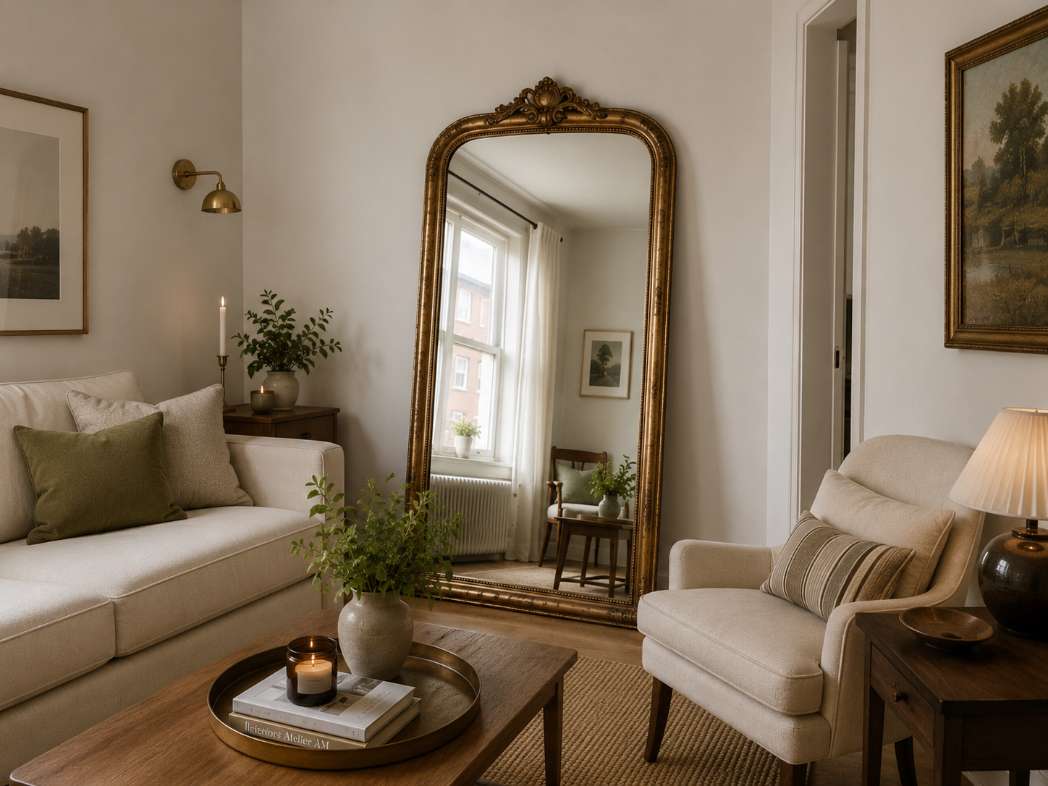
A large mirror leaned casually against the wall rather than hung creates the impression of a door or opening into another space — the room appears to continue beyond where it physically ends. This is the most effective single visual space-expanding tool available for any small living room.
The mirror reflects whatever is opposite it. Position it to reflect a window and it doubles the natural light in the room. Position it to reflect a beautiful corner styling vignette and it doubles the visual interest of that corner. Position it to reflect the light from a floor lamp and it multiplies the warm glow across the room.
Thrift stores, Facebook Marketplace, and garage sales are excellent sources for large mirrors at five to thirty dollars. A large ornate mirror in a dark or gold frame found secondhand does exactly the same job as a three-hundred-dollar designer version.
Cost: 5to30 thrifted, 40to80 budget new
Impact: Very high — one of the top three visual transformations on this list
Tips:
- Lean the mirror against the wall opposite or adjacent to a window for maximum light reflection
- A mirror in an ornate, substantial frame looks more expensive leaned casually than hung formally
- Clean the glass with white vinegar and newspaper for a streak-free finish that maximises the reflection quality
11. Create a Gallery of Small Mirrors
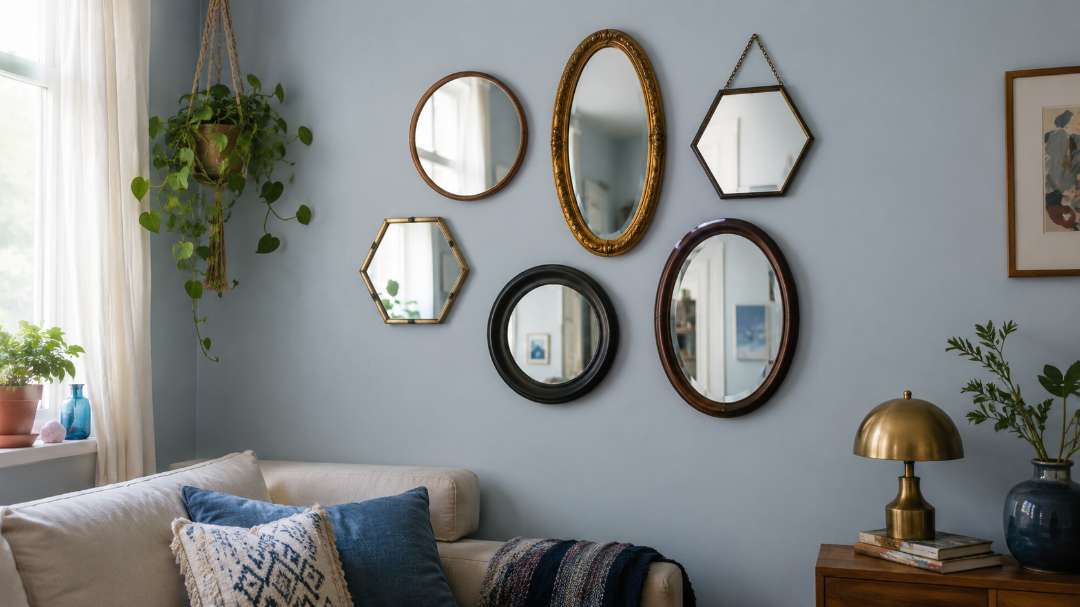
If one large mirror is impractical, a gallery of small mirrors — three to seven different shapes and frames arranged in a loose cluster on one wall — creates the same light-reflecting and space-expanding effect with more visual interest and more creative flexibility.
Collect small mirrors from thrift stores in different shapes — round, oval, hexagonal, arch-topped, and rectangular — and arrange them in an organic cluster rather than a formal grid. The variation of shapes and the reflective quality of multiple mirrors simultaneously creates a wall feature that is genuinely striking and deeply effective at making a small room feel more open and layered.
The different frames do not need to match. In fact, a variety of frame styles — one gold, one natural wood, one dark, one ornate — tied together by the shared reflective quality of the glass looks more curated and more intentional than a matching set.
Cost: 2to8 per mirror at thrift stores, 20to50 total for a gallery of six to eight
Impact: High — visual interest plus the practical mirror benefits
Tips:
- Arrange mirrors on the floor first and photograph the arrangement before committing to wall hooks
- The gallery works best when the mirrors overlap or nearly touch at the edges — too much space between them makes the cluster feel disconnected
- Mix in one or two non-mirror framed pieces — a botanical print, a small artwork — for a more interesting and less expected gallery wall
TEXTILES AND SOFT FURNISHINGS
12. Hang Curtains at Ceiling Height
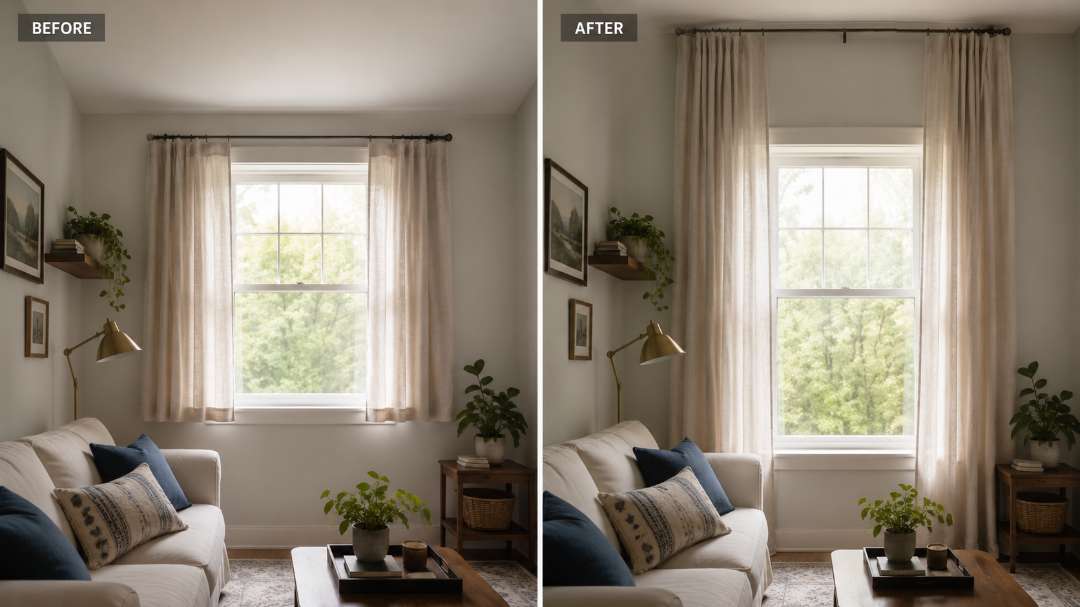
This is the curtain trick that changes everything. Most people hang curtains just above the window frame. This makes the window look exactly as small as it is, the ceiling feel exactly as low as it is, and the room feel exactly as small as it is.
Hanging curtains at ceiling height — or as close to it as possible — does the opposite of all three. The eye follows the curtain fabric upward from the floor to the ceiling, reading the height of the ceiling as the height of the window. The room feels taller. The window feels larger. The room feels more spacious.
The curtain rod should extend at least six inches beyond the window frame on each side, allowing the curtain to cover the wall beside the window when open. This reveals the maximum glass area, maximises natural light, and creates the impression of a much larger window than actually exists.
Cost: 15to40 for budget curtain panels, 5to15 for a curtain rod
Impact: Very high — one of the top three visual transformations on this list
Tips:
- Linen or linen-look curtains in warm white, cream, or soft sage are the most universally flattering choice for a small living room
- Floor-length curtains that just touch the floor look more expensive than curtains that stop short
- Avoid heavily patterned curtains in small rooms — they visually reduce the apparent size of the window
13. Layer Your Throw Pillows
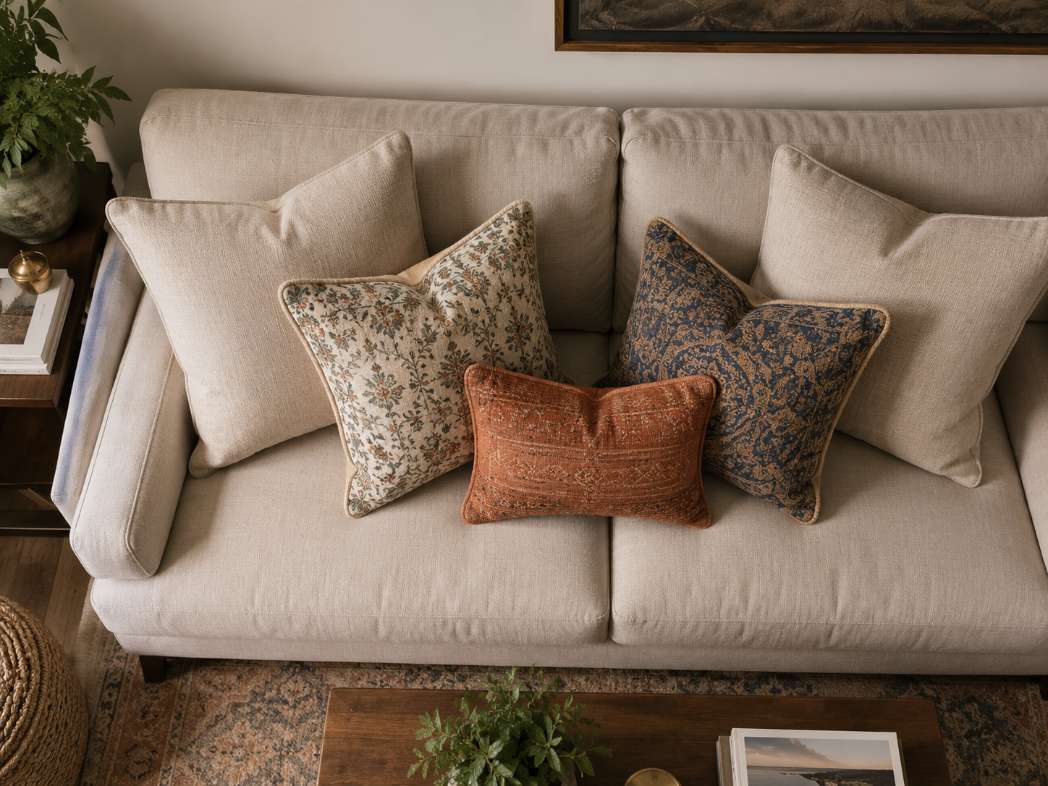
A sofa with a single set of matching throw pillows looks like it came straight from the showroom floor. A sofa with two or three different pillow sizes in complementary colours and textures looks like it was put together by someone with actual taste.
The layered pillow approach costs almost nothing if you already have pillows and buy one or two additional pillow covers to add variety. Pillow covers rather than full pillows are the budget-intelligent approach — one inexpensive insert, multiple covers that rotate seasonally and cost four to twelve dollars each.
The combination formula that always works: two larger pillows in a solid colour or subtle texture at the back, two medium pillows in a complementary pattern or texture in the middle, and one small lumbar pillow in an accent colour at the front. Five pillows in three sizes, two to three colours maximum.
Cost: 4to15 per pillow cover, 25to60 for a complete layered set
Impact: Medium-high — immediately makes a sofa look more styled and more expensive
Tips:
- Vary the textures as well as the colours — a velvet pillow, a linen pillow, and a woven pillow in complementary colours always look more expensive than three pillows in the same material
- Two to three colours maximum in a pillow arrangement — more than three creates chaos rather than intentional variety
- Odd numbers of pillows always look more naturally styled than even numbers
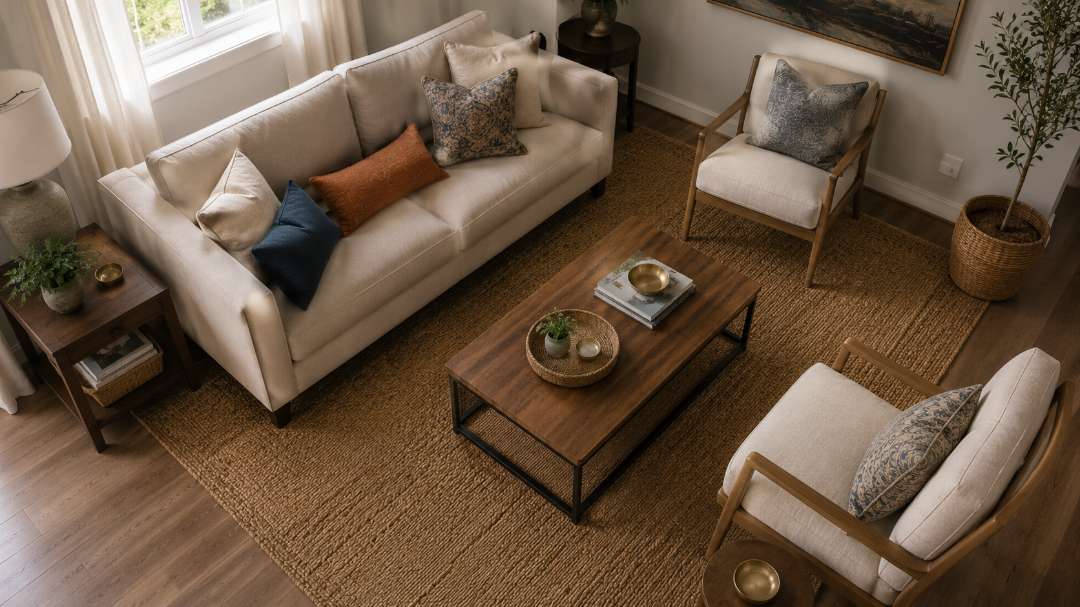
14. Add a Large, Neutral Area Rug
A rug is one of the most transformative purchases available for a small living room and one of the most commonly undersized. The single most prevalent budget living room mistake is buying a rug that is too small.
A correctly sized rug — large enough that the front legs of every sofa and chair in the seating arrangement rest on it — unifies the furniture into a defined zone and makes the room feel significantly larger and more intentionally designed. A small rug that sits in the middle of the seating arrangement without touching any furniture does the opposite — it makes the room look fragmented and smaller.
In a small living room, a five by seven foot rug is the minimum. Six by nine is often better. For budget options, IKEA, Amazon, Ruggable, and discount stores offer large area rugs in neutral tones for forty to one hundred dollars.
Cost: 40to100 for budget large rugs
Impact: Very high — one of the top three visual transformations on this list
Tips:
- A single large neutral rug looks more expensive than two smaller rugs of the same total footprint
- Natural fibre rugs — jute, cotton, wool blend — look more expensive than synthetic equivalents at the same price point
- A rug pad underneath makes any rug feel significantly more substantial and prevents slipping
15. Drape a Throw Blanket With Intention
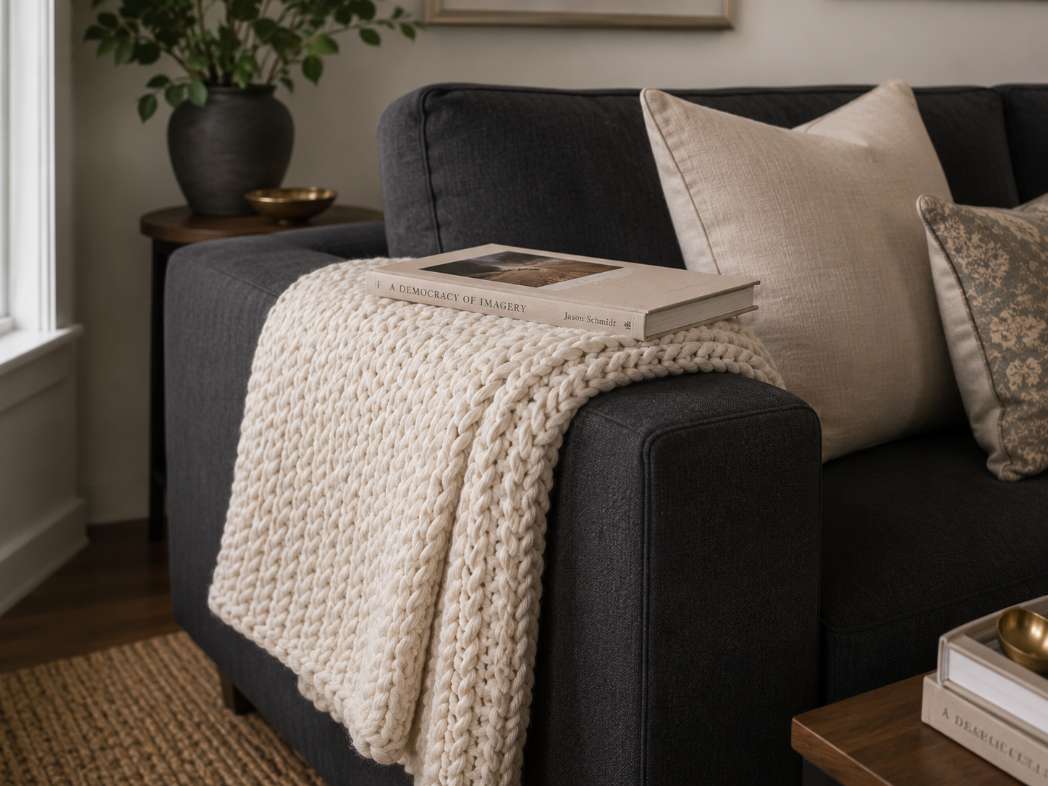
A throw blanket casually draped over the arm of a sofa or folded at one end is one of the easiest and cheapest ways to add colour, texture, and the impression of a layered, considered room. This is the styling trick that every home staging professional uses and that costs five to twenty dollars.
The key word is intention. A throw blanket tossed randomly looks like a throw blanket tossed randomly. A throw blanket folded in thirds and draped over the sofa arm, or arranged in a loose fold at the end of the seat cushions with the textured side visible, looks like a deliberate styling decision made by someone who knows what they are doing.
Waffle-knit, chunky knit, and woven cotton throws are the most visually effective because their textures are visible from across the room and add dimension to an otherwise flat sofa surface.
Cost: 10to30 at discount stores, TJ Maxx, or HomeGoods
Impact: Medium — significant contribution to the overall layered, styled look
Tips:
- Choose a throw in a colour that appears elsewhere in the room — in a pillow, a plant pot, a piece of artwork
- Fold the throw rather than spreading it — a folded throw looks more intentional than one laid flat
- Chunky knit throws photograph particularly well and create strong texture from a distance
SHELVING AND DISPLAY
16. Install Floating Shelves Above the Sofa or TV
Vertical wall space in a small living room is almost always underused. The walls above eye level — above the sofa, above the TV unit, beside the window — are prime real estate for storage, display, and the visual height-creating effect of drawing the eye upward.
Floating shelves installed above the sofa create a gallery-like display area that makes the room feel both more designed and more personal. Styled with a mixture of books, plants, candles, framed photos, and interesting objects, they contribute the layered, curated quality that is the hallmark of a room that looks expensive without being expensive.
Basic floating shelf systems from IKEA, Amazon, or hardware stores cost ten to twenty dollars per shelf. Installation with a drill and wall anchors takes approximately thirty minutes per shelf for a beginner.
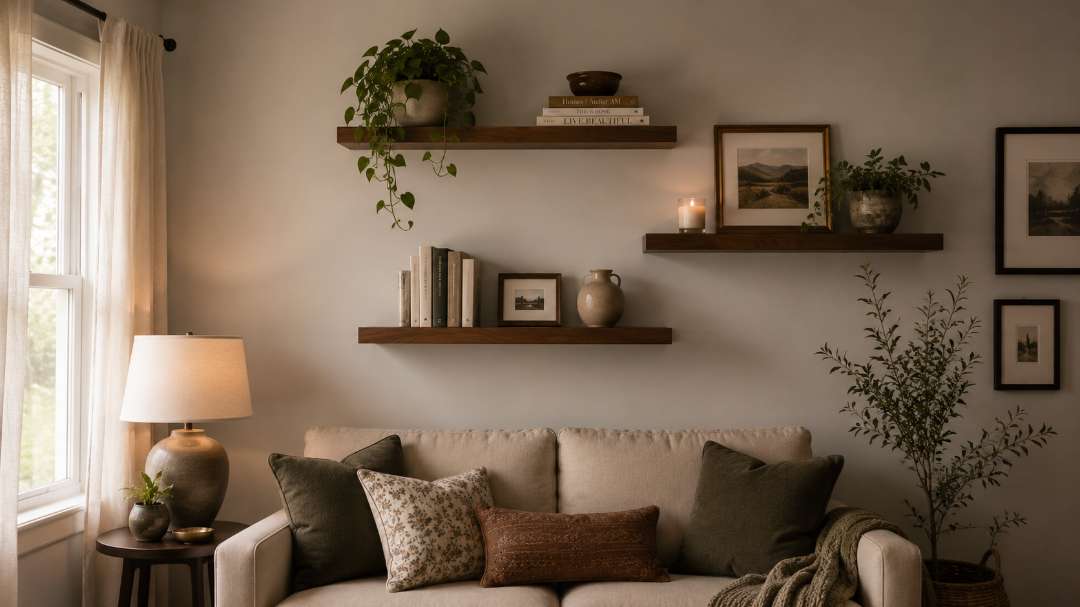
Cost: 10to20 per shelf plus installation
Impact: High — adds both storage and the visual effect of height and depth
Tips:
- Install shelves at three different heights for visual variety and to draw the eye upward
- Style shelves in the one-tall-one-medium-one-small object pattern for the most balanced arrangement
- Books are excellent shelf filler — style a few spines facing outward for colour and then turn the remaining books backward (spines inward) for a uniform, sophisticated look
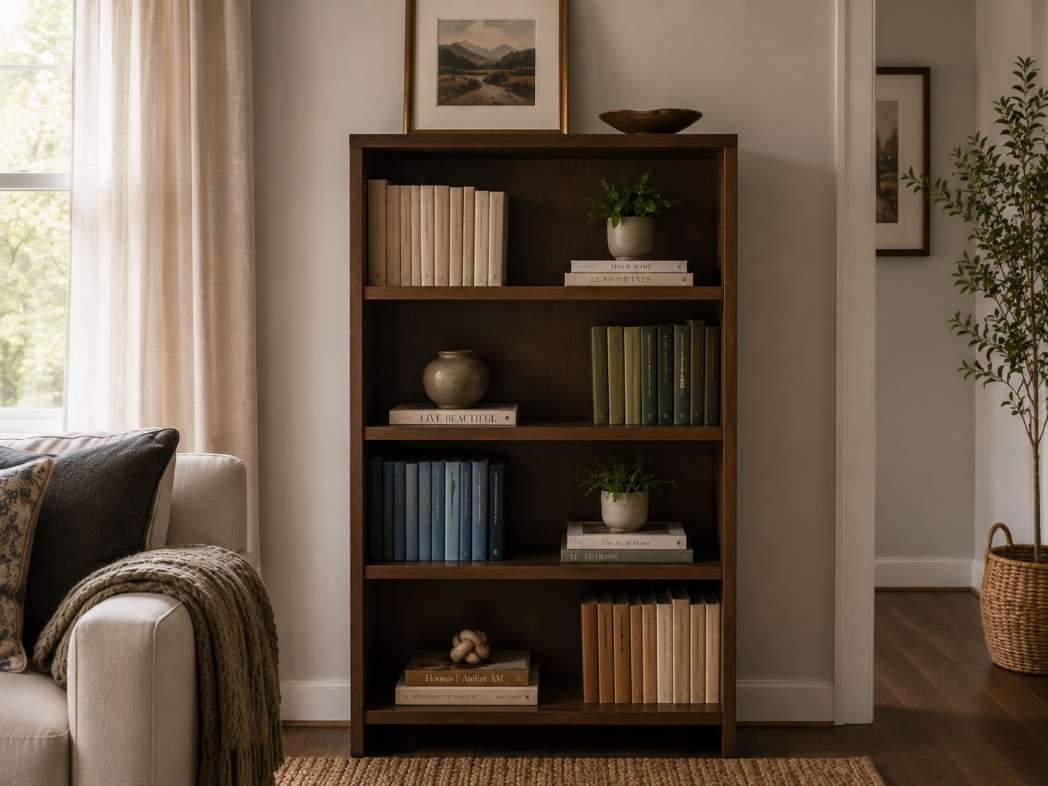
17. Style Your Bookshelf Like a Designer
If you already have a bookshelf in your small living room, restyling it costs nothing and can make it look like a piece from an expensive interior design shoot. The difference between a bookshelf that looks cluttered and one that looks curated is not the books — it is the curation.
Remove everything from the shelf. Clean every surface. Then replace items selectively, using this formula: for every three books, add one non-book decorative object. Vary the heights of book stacks — some vertical, some horizontal. Add one plant on the shelf where it has the most light. Add one candle. Remove approximately a third of what you started with, leaving intentional negative space.
The styling process takes one hour and the result is a bookshelf that looks like it was arranged by someone who has thought very carefully about every object on it — which, after following this process, you will have.
Cost: Free
Impact: Medium-high — particularly impactful in rooms where the bookshelf is a dominant feature
Tips:
- Group books by spine colour for a more visual, designed look
- Stand a few books horizontally in stacks as platforms for decorative objects
- Remove anything that does not contribute to the aesthetic — old bills, charging cables, random objects without visual purpose
PLANTS AND NATURE
18. Add One Large Statement Plant
A single large plant — a fiddle-leaf fig, a monstera, a snake plant, or a large pothos in a trailing arrangement — makes more visual impact in a small living room than twelve small plants scattered across the room.
The large plant fills vertical space, adds life and movement, brings colour and organic texture, and creates a natural focal point that draws the eye. It does all of this for the cost of one plant and one attractive pot.
The pot matters as much as the plant. A beautiful ceramic, terracotta, or woven pot transforms a practical plant into a design element. An ugly plastic pot does the opposite. Budget ceramic pots are available from garden centres and discount stores for five to fifteen dollars.
Cost: 15to40 for plant, 5to15 for a quality pot
Impact: High — one of the most effective organic, natural additions to a small living room
Tips:
- Place the large plant in a corner to fill dead space without obstructing movement
- Fiddle-leaf figs, monsteras, and bird of paradise plants all create strong architectural shapes that suit small living rooms
- A large dark-leafed plant against a light wall, or a light-leafed plant against a dark wall, creates the most dramatic visual contrast
19. Create a Plant Shelfie
Three to five plants of varying sizes styled together on a single shelf or in a single corner create the lush, layered plant aesthetic that is one of the defining visual signatures of a well-styled 2026 living room.
The combination of a tall plant at the back, a medium trailing plant in the middle, and one or two small plants at the front creates depth and visual interest that a single plant cannot achieve. The trailing plant — pothos, string of hearts, trailing tradescantia — provides movement as it cascades down from the shelf edge.
Propagate cuttings from existing plants for free additions. Ask friends for cuttings. Buy small starter plants and grow them over time. The investment in a plant shelfie builds over months and costs progressively less than the visual result would suggest.
Cost: 5to30 for a starting collection, growing over time
Impact: Medium-high — particularly effective as a corner or shelf feature
Tips:
- Vary pot materials — one terracotta, one ceramic, one wicker — for visual texture variety
- Group pots of different heights rather than placing them all on the same level
- One trailing plant in the arrangement is essential — the movement it creates cannot be replicated by upright plants
ARTWORK AND GALLERY WALLS
20. Create a Gallery Wall With Free Printables
A gallery wall is one of the most impactful design features available for a small living room — and it can be executed for under twenty dollars using free printable artwork downloaded from the internet and frames sourced from thrift stores.
Free art websites including Unsplash, The Artling, Freebie Supply, and numerous Etsy shops offer botanical prints, abstract line art, typographic pieces, and landscape photography as free downloads. Print at home on regular printer paper or take files to a print shop for a few dollars per print for larger format pieces.
Frame the prints in thrift store frames — cleaned, and fitted with the new prints. Arrange in a loose, organic cluster on the wall above the sofa or on the main feature wall. The result is a genuine gallery wall for fifteen to twenty dollars.
Cost: 5 for prints, 1to5 per frame at thrift stores — total 15to25
Impact: Very high — one of the most dramatically personalising features in a small living room
Tips:
- Arrange frames on the floor and photograph the arrangement before committing to wall holes
- A mix of frame sizes and one or two different frame colours creates a more natural, accumulated look than a matching set
- Include at least one larger frame as an anchor piece — six identical small frames look like a standard retail display rather than a curated gallery
21. Lean Artwork Against Walls Instead of Hanging
Large framed artwork or a mirror leaned casually against a wall rather than hung creates an effortlessly sophisticated, editorial look that suggests confidence and design awareness. It requires no drilling, no measuring, and no commitment — which makes it perfect for renters and for anyone who is not sure exactly where they want a piece long-term.
A large framed print or canvas leaned against the wall behind a console table, a shelf, or directly against the skirting board creates a layered, slightly undone quality that looks significantly more expensive than the same piece formally hung and centred on the wall.
Cost: Free if using existing pieces, 5to30 for thrifted frames with new prints
Impact: Medium-high — particularly effective for creating the impression of a designed, styled room
Tips:
- Lean artwork at a very slight angle rather than perfectly vertical for the most natural effect
- Layer two pieces of different sizes leaned against the same wall for a more curated look
- Place a small object in front of the leaned artwork — a plant, a candle, a stack of books — to tie it into the room’s overall styling
DECLUTTERING AND EDITING
22. Remove Half of What Is on Every Surface
This idea costs nothing and is one of the most immediately effective small living room transformations on the entire list. Walk through your living room with a box. Remove half of the objects from every surface — every shelf, every table, every window sill, every corner. Put them in the box. Put the box in another room.
Now look at the room.
Almost certainly it looks better. More spacious. More intentional. More like the room of someone who makes deliberate decisions rather than someone who accumulates without editing.
The objects in the box are not necessarily bad. They are simply too many for the space. Keep the box for two weeks. If you do not miss anything in it, donate or sell the contents. A small living room with fewer, better objects always looks more expensive than the same room crammed with everything you own.
Cost: Free
Impact: Very high — one of the most significant transformations on this list
Tips:
- Start with the items you are least attached to and work toward the pieces you love
- If it does not serve a function and does not bring genuine visual pleasure, it should be in the box
- Flat surfaces — coffee tables, TV units, window sills — should have no more than three objects on them
23. Organise and Conceal All Cables
Visible cables and wires make even the most beautifully decorated living room look messy, unfinished, and cheap. Cable management is a small thing with a disproportionate impact on the overall polish of a space.
Cable management channels — adhesive plastic channels that run along skirting boards and walls, hiding cables within — cost five to fifteen dollars and take under an hour to install. Cable boxes that contain all the plugs and adapters behind the TV unit cost ten to twenty dollars and immediately transform the visual clutter around a TV setup.
For a quick, free version of cable management, gather all visible cables into one tight bundle and use a cable tie or velcro strip to hold them together. The bundle of cables reads as a single organised element rather than a chaotic tangle.
Cost: 5to20 for cable management solutions
Impact: Medium — most noticeable as part of an overall tidy, edited room
Tips:
- Start with the TV area which typically generates the most visible cable clutter
- Use cable clips to run cables along the inside edge of furniture rather than across visible floor space
- A TV unit with closed storage is vastly preferable to an open TV unit for cable management purposes
STYLING DETAILS
24. Use Books as Decor Throughout the Room
Books are one of the most versatile, most affordable, and most personality-revealing decorating tools available. A stack of books in an interesting colour family on the coffee table with a small plant or candle on top. Books on the mantelpiece propped between decorative objects. Books on open shelves styled with their spines outward or inward for colour coordination. A single large art book opened to a beautiful spread and left on the ottoman.
Books communicate that a room is lived in and loved by someone with interests and aesthetic awareness. They cost nothing if you already own them and next to nothing from thrift stores where excellent hardcover books in beautiful colours are available for fifty cents to two dollars each.
Cost: Free if using existing books, 0.50to2 per book at thrift stores
Impact: Medium — contributes significantly to the layered, personal quality of a styled room
Tips:
- Look for books with beautiful spines at thrift stores — coffee table art books, architecture books, and nature books often have stunning cover and spine designs
- Style books spines-outward in a colour grouping — all warm tones, or all dark, or all light — for a more considered look
- Horizontal stacks of three to four books serve as platforms for small plants, candles, or decorative objects on any surface
25. Add Candles and Ambient Scent
Candles in a small living room serve two functions simultaneously: they are visual decorating elements when unlit, and they are atmospheric when burning. A group of three pillar candles of varying heights on a tray on the coffee table or mantelpiece adds warmth, texture, and the suggestion of intentional evening living.
Scent is the element of room decoration that is most often overlooked — and one of the most powerful. A small living room that smells wonderful creates an impression of quality and care that extends to the entire space. A candle, a reed diffuser, or a room spray in a considered scent (cedar, sandalwood, warm linen, eucalyptus, or vanilla) does this for five to twenty dollars.
Cost: 5to20 for candles and diffusers
Impact: Medium — particularly significant for the multisensory impression of a well-cared-for room
Tips:
- Group candles in odd numbers at varying heights for a deliberately styled arrangement
- A small tray or plate underneath candles unifies them into a single cohesive vignette
- Unscented candles for styling, scented candles or diffuser for fragrance — using multiple conflicting scented candles creates an unpleasant layered effect
26. Create One Perfect Styled Corner
Rather than attempting to style the entire room at once, choose one corner and make it perfect. A chair and a floor lamp. A small side table with a plant, a candle, and a stack of books. A rug piece extending from the main area rug or a small additional rug defining the corner.
This styled corner becomes the room’s focal point — the vignette that photographs most beautifully, that visitors notice first, and that gives the room its character and intentionality. A single perfectly styled corner makes the entire room feel more designed than it is.
Cost: Free if rearranging existing pieces, 20to50 if adding one or two new elements
Impact: High — a perfect corner reading nook or styled area anchors the aesthetic of the whole room
Tips:
- The corner should have at least three layers of interest: furniture, lighting, and a decorative object
- A chair facing slightly into the room rather than into the corner creates a more welcoming arrangement
- This is the corner to photograph and share on Pinterest — let it be the best representation of your space
27. Keep It Seasonal
The most expensive-looking small living rooms are never static. They shift with the seasons — a swap of throw pillow covers, a change of the throw blanket, a new plant for the shelf, a different candle scent. This seasonal updating creates the impression of a living space that is continuously tended and loved.
Each seasonal update costs next to nothing — two pillow covers, one new candle, a small bunch of dried flowers from the farmer’s market. But the cumulative effect of a room that is always slightly current, always reflecting the time of year, always showing evidence of care and attention, is one that consistently reads as more beautiful and more expensive than rooms that are set once and left unchanged.
Cost: 5to30 per seasonal refresh
Impact: Medium-high — the ongoing freshness of a seasonally updated room contributes enormously to its overall quality
Tips:
- Focus seasonal updates on textiles and botanicals — the most affordable and most impactful elements to change
- Keep a box of seasonal decorating items — autumn candles, spring florals, winter throws — that rotate in and out rather than accumulating simultaneously
- Even a single bunch of fresh seasonal flowers, changed weekly, makes a small living room feel more alive and more considered than any permanent decoration
The Top 5 Ideas by Impact vs. Cost
| Idea | Cost | Visual Impact | Difficulty |
|---|---|---|---|
| Warm bulb replacement | 10to15 | ★★★★★ | Very Easy |
| Curtains hung ceiling height | 20to55 | ★★★★★ | Easy |
| Large mirror leaned on wall | 5to30 | ★★★★★ | Very Easy |
| Gallery wall with free prints | 15to25 | ★★★★★ | Easy |
| Deep accent wall paint | 20to40 | ★★★★★ | Easy |
Budget Breakdown — What to Do With 50,100, and $200
With $50
Change all light bulbs to warm 2700K (12).Addstringlightsabovethesofa(12). Lean a thrifted large mirror against the wall (10to20). Rearrange all furniture away from the walls (free). Declutter every surface (free). Style the coffee table with existing books and candles.
With $100
Everything in the 50planplus:hangcurtainsatceilingheight(35 to 50).Createagallerywallwiththriftedframesandfreeprintableart(15 to 25).Addonestatementplantinabeautifulpot(20 to $30).
With $200
Everything in the 100planplus:addalargeneutralarearug(50 to 100).Paintoneaccentwall(20 to 40).Buyastorageottomanforthecoffeetablearea(40 to 60).Completethestyledcornerwithafloorlamp(20 to $30 thrifted).
Frequently Asked Questions
What makes a small living room look expensive?
The three qualities that most reliably make a small living room look expensive are intentionality, restraint, and warmth. Intentionality means every object and every arrangement looks deliberately chosen. Restraint means fewer, better pieces rather than many mediocre ones. Warmth means layered warm lighting, natural materials, and a colour palette that feels enveloping rather than clinical. All three are achievable with minimal spending.
What is the most impactful free change to a small living room?
Changing the bulbs to warm white 2700K LEDs and repositioning the furniture away from the walls together cost approximately twelve dollars and take twenty minutes, and together represent the single highest-impact investment of money and time on this list. The lighting change is transformative. The furniture repositioning is revelatory. Do both before spending anything else.
How do I make a small living room feel bigger?
The most effective space-expanding tools in a small living room are mirrors (reflecting light and creating the impression of depth beyond the wall), curtains hung at ceiling height (making the ceiling feel higher), furniture floated away from the walls (creating a defined zone rather than a perimeter of furniture), and a single large rug (unifying the space into one cohesive zone). All four together cost under one hundred dollars and make a significantly more meaningful difference to perceived space than expensive furniture choices.
What colours make a small living room look expensive?
Deep, saturated colours — forest green, midnight navy, warm terracotta, rich plum, and charcoal — paradoxically make small rooms feel more expensive than safe neutral palettes. This is because dark, confident colours communicate design assurance in a way that beige and greige do not. Warm neutrals — cream, warm white, and oat — also work well and are the most universally flattering base palette for small living rooms that want to look expensive.
Final Thought — Intention Is the Most Expensive Thing in Any Room
None of these twenty-seven ideas require significant money. Several require no money at all. What they require is time, attention, and the willingness to make deliberate choices rather than accumulative ones.
The living room that looks expensive is the one that looks like someone thought carefully about every single thing in it. Every light source, every object on every surface, every piece of furniture and where it sits and what it faces. That kind of thoughtfulness is not available at any price point. It has to come from you.
Start with the one idea on this list that costs nothing. Then the one that costs least. Then the next. Your small living room does not need a bigger budget. It needs better decisions — and you have just read twenty-seven of them.
Save this guide to your home decor Pinterest board and share your small living room transformation in the comments. We would love to see what you do with it.
Primary keyword: small living room ideas that look expensive on a budget
Supporting keywords: budget small living room decor, affordable living room transformation, make small room look bigger, cheap living room ideas 2026, cozy small living room aesthetic
You Might Also Like
- Budget Friendly Small Room Decor Ideas Aesthetic 2026
- Dark Cottagecore Kitchen Ideas 2026
- 12 Spring Nails Aesthetic Ideas for 2026
- Minimalist Pastel Blooming Flower Nail Art for Short Nails 2026